

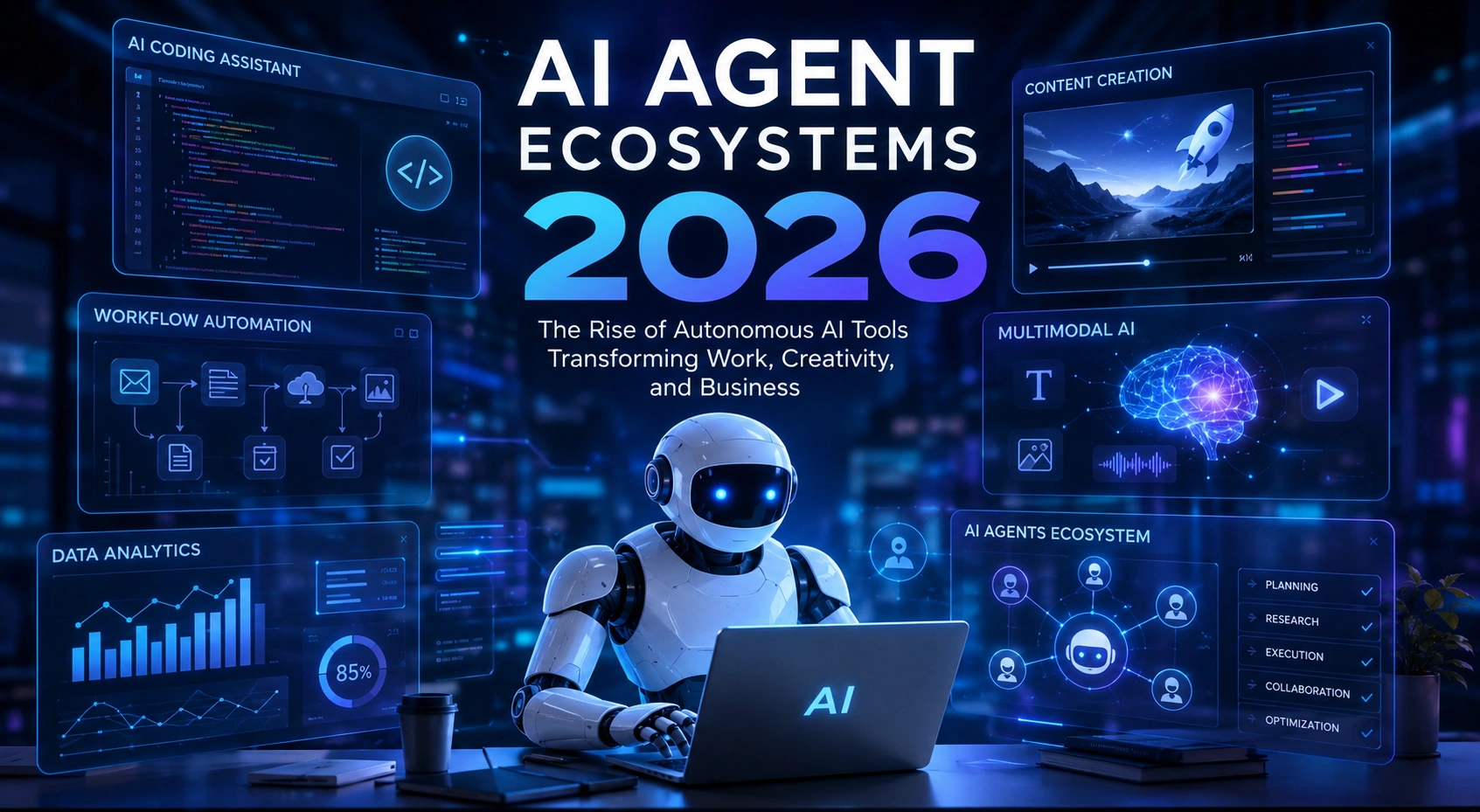
AI Agents in 2026: How Autonomous AI Is Transforming Software Development
AI agents are revolutionizing software development in 2026 by automating coding, testing, deployment, and project management tasks. These autonomous AI systems can understand objectives, execute complex workflows, and collaborate with developers to build software faster and more efficiently. In this article, we explore how AI agents work, their impact on software engineering, real-world applications, benefits, challenges, and what the future holds for autonomous AI development.
The software development industry is experiencing one of its biggest transformations since the rise of cloud computing. Artificial Intelligence has evolved beyond simple chatbots and code-completion tools into intelligent AI agents capable of performing complex development tasks with minimal human intervention.
In 2026, autonomous AI systems are helping developers write code, debug applications, automate testing, manage infrastructure, and optimize software delivery pipelines. As businesses seek greater efficiency and faster innovation, AI agents are becoming indispensable tools in modern software engineering.
This shift is not about replacing developers; instead, it is about augmenting human capabilities and enabling teams to focus on creativity, architecture, and strategic decision-making.
What Are AI Agents?
AI agents are intelligent software systems designed to perform tasks independently by understanding goals, making decisions, and executing actions.
Unlike traditional AI assistants that simply respond to prompts, AI agents can:
- Analyze complex requirements
- Break tasks into smaller objectives
- Execute multi-step workflows
- Learn from previous interactions
- Collaborate with other systems and tools
- Continuously optimize their performance
These capabilities allow AI agents to function more like autonomous digital workers than simple software tools.
How AI Agents Are Changing Software Development
1. Autonomous Code Generation
Modern AI agents can generate complete applications from natural language instructions.
Developers can describe a project, feature, or business requirement, and AI agents can:
- Create project structures
- Generate code files
- Build APIs
- Develop user interfaces
- Configure databases
This significantly reduces development time while improving productivity.
2. Intelligent Debugging and Error Detection
Debugging is one of the most time-consuming aspects of software development.
AI agents can automatically:
- Detect bugs
- Analyze stack traces
- Suggest fixes
- Refactor problematic code
- Prevent recurring issues
This helps development teams maintain higher code quality and faster release cycles.
3. Automated Software Testing
Quality assurance is becoming increasingly automated through AI-powered testing systems.
AI agents can:
- Generate test cases
- Perform regression testing
- Detect vulnerabilities
- Simulate user behavior
- Identify edge cases
As a result, teams can deliver more reliable software with fewer manual testing efforts.
4. DevOps and Infrastructure Automation
AI agents are transforming DevOps by automating infrastructure management.
Key applications include:
- Server configuration
- Deployment management
- Resource optimization
- Monitoring and alerts
- Incident response
This allows organizations to maintain scalable and resilient systems with reduced operational overhead.
Real-World Applications of AI Agents
SaaS Development
Software companies are using AI agents to accelerate product development and release new features faster.
Enterprise Automation
Large organizations leverage autonomous AI systems to streamline workflows, reduce costs, and improve operational efficiency.
Cybersecurity
AI agents help identify threats, monitor systems, and respond to security incidents in real time.
Customer Support Platforms
Advanced AI agents can resolve support requests, manage tickets, and provide personalized assistance without human intervention.
Benefits of AI Agents in Software Engineering
Increased Productivity
Developers spend less time on repetitive tasks and more time solving complex problems.
Faster Development Cycles
Projects move from idea to deployment significantly faster.
Improved Code Quality
AI-powered analysis reduces bugs and promotes best practices.
Cost Efficiency
Automation lowers development and operational expenses.
Scalability
AI agents can handle growing workloads without requiring proportional increases in team size.
Challenges and Limitations
Despite their advantages, AI agents still face several challenges.
Accuracy Concerns
Generated code may occasionally contain errors or security vulnerabilities.
Data Privacy Risks
Organizations must ensure sensitive data remains protected when using AI systems.
Human Oversight Requirements
AI-generated decisions often require review and validation by experienced developers.
Ethical Considerations
Questions around accountability, transparency, and responsible AI usage continue to evolve.
The Future of Autonomous AI Development
The next generation of AI agents will become increasingly capable of managing entire software projects from planning to deployment.
Future advancements may include:
- Self-improving AI systems
- Autonomous software maintenance
- AI-led project management
- Intelligent architecture design
- Fully integrated development ecosystems
As these technologies mature, developers will work alongside AI agents as collaborative partners rather than simple tools.
Will AI Replace Software Developers?
One of the most common questions surrounding AI is whether it will replace programmers.
The reality is that AI agents are more likely to transform the role of developers rather than eliminate it.
Human expertise remains essential for:
- Strategic decision-making
- Creative problem-solving
- Business understanding
- System architecture
- Ethical oversight
Developers who learn to work effectively with AI agents will likely gain a significant competitive advantage in the future job market.
Conclusion
AI agents are reshaping software development in 2026 by introducing unprecedented levels of automation, efficiency, and intelligence. From autonomous coding and testing to infrastructure management and workflow optimization, these systems are helping organizations build better software faster than ever before.
While challenges remain, the future of software engineering will increasingly involve collaboration between human developers and intelligent AI agents. Those who embrace this transformation today will be better positioned to succeed in the rapidly evolving technology landscape.