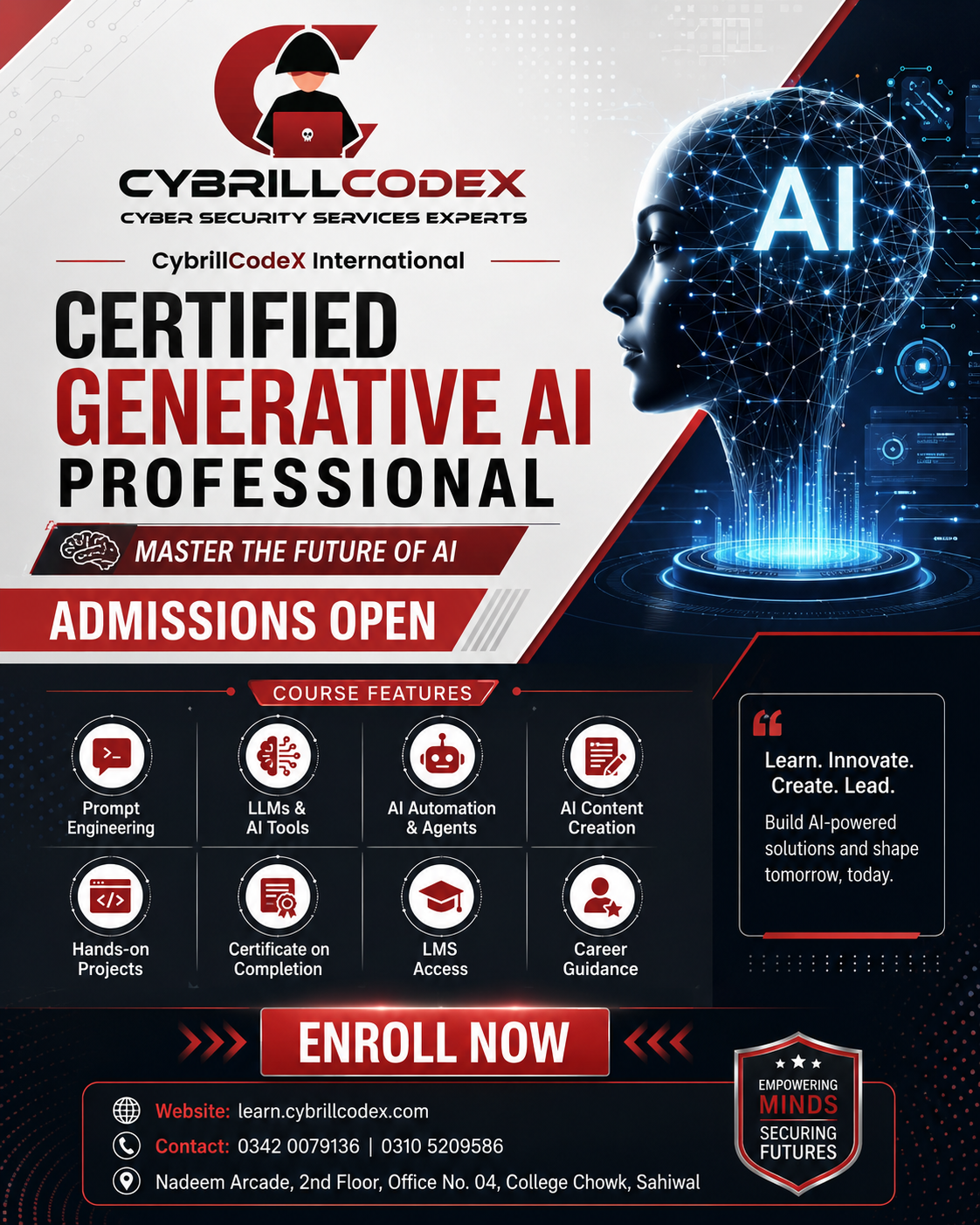
Welcome to the Certified Generative AI Professional program! This cutting-edge 3-month course is designed to transform you into a skilled, job-ready Generative AI practitioner — capable of building, fine-tuning, deploying, and operationalising large language models, image generation systems, and AI-powered applications across real-world business and technical contexts.
Generative AI is the most disruptive technology of the decade. From GPT-4 and Claude to Stable Diffusion and Midjourney, businesses across every sector are racing to integrate generative AI into their products, workflows, and services. The professionals who understand how to work with these systems at a technical level — prompt engineering, RAG pipelines, fine-tuning, LLM API integration, and AI agent development — are among the most sought-after in the global technology market. This program gives you that expertise, grounded in hands-on project work with real AI systems and production deployment scenarios.
Why Choose This Course?
- Hands-On with Real AI Systems: Work directly with OpenAI GPT-4o, Anthropic Claude, Google Gemini, Llama 3, Mistral, and Stable Diffusion — not just theory, but live API integration, prompt engineering, and model interaction throughout the program.
- RAG and LLM Application Development: Master Retrieval-Augmented Generation (RAG) pipelines and LangChain to build intelligent, context-aware AI applications that go far beyond basic chatbots.
- Fine-Tuning and Model Customisation: Learn how to fine-tune open-source LLMs on custom datasets using LoRA and QLoRA techniques — a skill that very few developers possess and that commands premium salaries.
- AI Agents and Automation: Build autonomous AI agents with tool use, memory, and multi-step reasoning using LangChain Agents and AutoGen — the next frontier in enterprise AI automation.
- Image and Multimodal AI: Explore image generation with Stable Diffusion and DALL-E 3, multimodal model capabilities, and how to build AI systems that work across text, image, and audio modalities.
- Career Support: AI portfolio guidance, CV review, LinkedIn profile optimisation, and access to our partner network of AI-first startups and technology companies actively hiring generative AI professionals.
Tools & Technologies Covered
- OpenAI API (GPT-4o, GPT-4 Vision, DALL-E 3, Whisper, Embeddings) for LLM application development
- Anthropic Claude and Google Gemini APIs for multi-provider LLM integration strategies
- LangChain and LlamaIndex for building RAG pipelines, document QA systems, and LLM orchestration
- Hugging Face Transformers and Datasets library for accessing and fine-tuning open-source models
- LoRA and QLoRA (PEFT library) for parameter-efficient fine-tuning of large language models
- Stable Diffusion (via Automatic1111 and ComfyUI) for image generation, ControlNet, and inpainting
- LangChain Agents and AutoGen for building autonomous multi-step AI agent systems
- ChromaDB, Pinecone, and FAISS for vector database storage and similarity search in RAG systems
- FastAPI and Streamlit for building and deploying AI-powered web applications and APIs
- Python, Jupyter Notebooks, and Google Colab as the primary development and experimentation environment
- Docker and Hugging Face Spaces for containerising and deploying generative AI models and applications
Hands-On Projects
Throughout the 3 months you will build a professional generative AI portfolio including:
- Custom AI Chatbot with RAG: Build a domain-specific chatbot that ingests your own documents, stores embeddings in a vector database, and answers questions with accurate, cited, context-aware responses using LangChain and ChromaDB.
- LLM Fine-Tuning Pipeline: Fine-tune an open-source LLM (Llama 3 or Mistral) on a custom dataset using LoRA/QLoRA, evaluate the model against the base model, and document the training pipeline end-to-end.
- AI Image Generation System: Build a Stable Diffusion image generation application with custom prompt engineering, ControlNet conditioning, style consistency, and a Streamlit frontend for user interaction.
- Autonomous AI Agent: Design and build a multi-tool AI agent using LangChain Agents that can search the web, read documents, execute code, and complete multi-step tasks autonomously.
- Capstone: Production AI Application: Design, build, and deploy a complete generative AI-powered application — an AI writing assistant, AI customer support system, or AI content generation pipeline — with a FastAPI backend, Streamlit frontend, and Docker deployment.
Who This Course Is For
- Software developers and Python programmers who want to specialise in generative AI application development
- Data scientists and ML engineers who want to move into the LLM and generative AI space
- AI enthusiasts with programming knowledge who want to build real, deployable generative AI systems
- Product managers and technical leads who want a deep understanding of what generative AI can and cannot do
- Entrepreneurs and technical founders who want to build AI-native products and startups
- Anyone with a programming background who wants to enter one of the highest-paying and fastest-growing fields in technology
Career Opportunities
Upon completing this course you will be prepared for roles such as:
- Generative AI Engineer and LLM Application Developer
- Prompt Engineer and AI Systems Designer
- AI/ML Engineer with Generative AI Specialisation
- RAG Pipeline Developer and Knowledge Base AI Engineer
- AI Product Developer and AI Solutions Architect
- Fine-Tuning and Model Customisation Specialist
- AI Automation and Intelligent Agent Developer
- Freelance AI Developer and Generative AI Consultant
Learning Mode
Hybrid Learning: Attend classes physically at our campus or join online via live interactive sessions.
- Live Classes: Monday to Friday, 9:00 AM – 12:00 PM
- Recorded Sessions: Access all class recordings anytime for revision at your own pace
- Online Support: Get help via WhatsApp community and scheduled mentoring sessions
- Practical Labs: Hands-on AI development sessions every week — live coding with LLM APIs, RAG pipeline construction, fine-tuning runs, and agent building with instructor guidance
- Project Reviews: Structured technical code reviews and AI system feedback at every project milestone throughout the program
- AI Community Access: Join our generative AI developer community for peer collaboration, prompt engineering challenges, hackathon participation, and exposure to live AI industry job opportunities
Whether you are a developer ready to ride the biggest wave in technology, an AI enthusiast who wants to go beyond using AI tools to actually building them, or a professional who wants to future-proof their career — this 3-month program gives you the technical depth, hands-on project experience, and industry recognition to succeed as a Certified Generative AI Professional.